


What Happened? The AIG Bonus Kerfuffle
By Brian | March 17, 2009
[The third in a series of “What Happened” posts that endeavor to explain the causes and impacts of the Current Financial Crisis(TM) – the first two parts are available here and here.]
Today’s discussion is inspired by AIG’s payment of retention bonuses last Sunday, March 12, 2009, and the stinging reaction it engendered from Barack Obama, Barney Frank, Ben Bernanke and others. As before, those who are bored by such things should move along quickly and quietly.
Categories: Money Talk, Political Rantings | 10 Comments »
Life Finds a Way
By Brian | March 17, 2009
An interesting juxtaposition of news articles over at The Speculist:
At this point, just about everyone knows that President Obama lifted the Stem Cell research ban imposed by George W. Bush at the beginning of his presidency. Less reported, though equally exciting is this story about a breakthrough in the use of induced pluripotent stem cells (iSPC’s), which are stem cells derived from somatic cells in adults.
Stem cells derived from adults are attractive for several reasons: they’re far easier to collect, they avoid the moral objections held by some about embryonic stem cells, and perhaps most importantly, they represent stem cells that exactly match the genes of the person in need of treatment.
So, good news all around. But here’s the part that really bends the mind:
What role did [George W. Bush’s] restrictions play in inducing some researchers to begin working on iPSCs? Seeing as the work described [in the linked article] comes from Canada and the UK, it would be difficult to draw a direct line. But it would be, to say the very least, ironic if the much-hated stem cell research funding ban actually played a positive role in moving us towards a better solution.
This is another case of unintended consequences from government incentive programs. Those who oppose embryonic stem-cell research were generally seeking a ban on the this type of research altogether. The lack of funding in that area, though, has led (some) scientists to focus on ways to achieve the same results a different way. Would we have seen the benefits of stem-cell research sooner without the ban? Perhaps. But would anyone have ever focused on adult stem-cells if the ban hadn’t existed?
Categories: The Future is Now | 9 Comments »
Geek Humor
By Brian | March 13, 2009
xkcd.com is always funny, but this one really made me laugh out loud:

(hat tip: Bill Napier)
Categories: Random Acts of Blogging | 1 Comment »
New Photo of Abraham Lincoln Found
By Brian | March 10, 2009
I find this story fascinating:
[President Ulysses S.] Grant’s 38-year-old great-great-grandson, Ulysses S. Grant VI, had seen [an old photo of the White House] before, but didn’t examine it closely until late January. A tall figure in the distance caught his eye, although the man’s facial features are obscured.
He called Keya Morgan, a New York-based photography collector and Lincoln aficionado, who helped identify it as Lincoln.
Morgan talked Grant into taking the photo out of the album and examining it for clues, such as the identity of the photographer.
Grant carefully removed it and was shocked to see the handwritten inscription on the back: “Lincoln in front of the White House.” Grant believes his great-grandfather, Jesse Grant, the general’s youngest son, wrote the inscription. Also included was the date 1865, the seal of photographer Henry F. Warren, and a government tax stamp that was issued for such photos to help the Civil War effort between 1864 and 1866.
Morgan recalled the well-documented story of Warren’s trip to Washington to photograph Lincoln after his second inauguration in March 1865. Lincoln was killed in April, so the photo could be the last one taken of him.
Warren, a commercial photographer from Massachusetts, enticed Lincoln into his frame shortly after the inauguration by taking pictures of young Tad Lincoln and asking the boy to bring his father along for a pose, according to the book, “Lincoln in Photographs: An Album of Every Known Pose,” by Charles Hamilton and Lloyd Ostendorf. “This is the first act of paparazzi ever toward a president,” Morgan said. “Lincoln is not too happy at all.”
Here’s the photo:
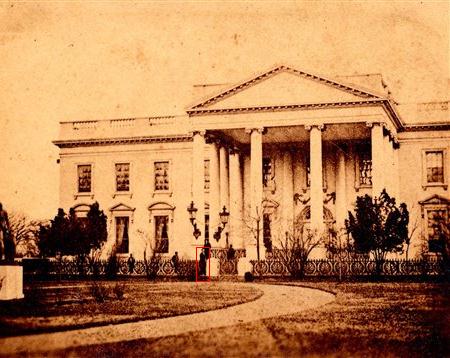
I’ve highlighted Lincoln with a thin, red box. In the computer-enhanced, blown-up version, you can see his distinctive beard, as well as the fact that he towers over everyone else in the picture:

The Associated Press speculates that this may be not only the last photograph taken of Lincoln (he was shot and killed roughly a month later), but it also may be the first photograph ever taken of a U.S. President in front of the White House. Given how many photographs have been taken of Presidents in front of the White House since, I think this is quite the find.

It also brings to mind a conversation we’re having over at Jason Bennion’s Simple Tricks & Nonsense about the nostalgic value of physical media versus the more modern, digital media. In my home office, we have a wall-to-wall bookshelf of photo albums containing more than twenty years of photographs that my wife has taken over the years. Each and every one of them has a brief note written on the back, describing who is in the picture and where/why it was taken. About eighteen months ago, the volume of digital pictures we take and the dwindling number of places that will actually print photographs for you has led us to abandon this impressive collection, and instead rely on the (somewhat equally impressive) electronic collection on our hard drive. Finding a picture of a given person online involves typing their name into Vista’s search box, whereas finding one in the photo albums involves pulling several volumes off the shelf and leafing through the pages.
In the case of Grant and Lincoln, it’s fortuitous that Jesse Grant was like my wife in regards to his photo archiving skills. 130 years from now, though, almost every surviving picture of Barack Obama will likely be digitally tagged with his name, as well as the date, time, and location in the photograph, greatly reducing the possibility that an important photo would be lost in a photo album, or remain unidentified because no one ever bothered to remove it from it’s plastic sleeve.
Categories: Random Acts of Blogging | 6 Comments »
Validation from Above
By Brian | March 9, 2009
Me:
Many of the boutique firms, who existed solely because of the MBS market, went out of business quickly, since they had little to no leverage to write and hold mortgages themselves. This made it even harder to get a loan, because it reduced the supply of available creditors.
(It also meant that the worst actors in this whole scenario had vanished, leaving Congress, the President and the media to assign blame to other, less nefarious players, such as Wall Street CEO
Categories: Money Talk | 2 Comments »
The Return of Mangled Speechifying
By Brian | March 6, 2009
They told us that when George W. Bush left office, the days of politicians who couldn’t put a sentence together would be long gone.
Oh, how wrong they were.
First up, Vice President Joe Biden, discussing the website that the Obama administration has setup to track stimulus spending:
You know, I’m embarrassed. [to an aide off-camera:] Do you know the Web site number? I should have it in front of me and I don’t. I’m actually embarrassed.
Not to worry, Mr. Vice President. If you get confused, all you need to do is check your tube. Each tube has it’s own number, after all…
Moving on to our Secretary of State, Hillary Clinton, speaking to 500 young Europeans at the European Parliament:
I have never understood multiparty democracy. It is hard enough with two parties to come to any resolution, and I say this very respectfully, because I feel the same way about our own democracy, which has been around a lot longer than European democracy
So, wait – our democracy has been around since the days of ancient Greece? Maybe we can resolve that whole “dinosaurs roamed the earth with humans” thing after all…
For the record, she also referred to EU Foreign Policy Chief, Javier Solana, as “High Representative Solano” (no word if he actually was high at the time), and European Commission External Relations Commissioner Benita Ferrero-Waldner as “Benito.”
The reaction? Parliament President Hans-Gert Poettering:
What you said mostly could have been said by a European
Really? Which European, exactly?
Finally, we leave actual politics and enter the world of political commentary, both to increase the bi-partisanship of this post, and also because there’s a certain kind of joy that comes from poking fun at Rush Limbaugh:
We want every American to be the best he or she chooses to be. We recognize that we are all individuals. We love and revere our founding documents, the Constitution and the Declaration of Independence. We believe that the preamble of the Constitution contains an inarguable truth, that we are all endowed by our creator with certain inalienable rights, among them life, liberty, freedom — and the pursuit of happiness
Well, maybe you believe that’s in the Preamble, Rush. I think it sounds a lot more like the Declaration of Independence. Except, believe it or not (and I’ll admit I found this surprising), the Declaration never once mentions the word “Freedom.”
Sigh…at least they can all pronounce “nuclear.”
Categories: Political Rantings | 5 Comments »
Maintenance-Free Pets
By Brian | March 6, 2009
Via Speculist, we present an invention for people who have a dog, but don’t really want to have a dog:
Categories: The World Wide Weird | 2 Comments »
Time Magazine: 25 People to Blame for the Financial Crisis
By Brian | March 5, 2009
A few weeks back, Time Magazine published a list of the 25 People to Blame for the Financial Crisis, in which it details the 25 people (or groups of people) that it considers most “blameworthy.”
Unfortunately, it’s website requires you to click “Next” twenty-five times to see the entire list, which is pretty inconvenient. So, as a public service, here’s the complete list:
- Angelo Mozilo, co-founder of Countrywide and IndyMac. Made predatory lending into a big business.
- Phil Gramm, chairman of the Senate Banking Committee from 1995-2000. Repealed the Glass-Steagall Act in 1999 and modified the 2000 Commodity Futures Modernization Act to exclude OTC derivatives from CFTC regulation.
- Alan Greenspan, chairman of the Federal Reserve, 1987 – 2006. Kept interest rates low through the booming 90s.
- Chris Cox, chairman of the Securities and Exchange Commission, 2005-2009. Didn’t catch Bernie Madoff or sufficiently police the I-Banks.
- American Consumers, borrowed up to 130% of their income by 2007.
- Hank Paulson, Treasury Secretary, 2006-2009. Let Lehman fail, mis-managed the original bailout bill/TARP program.
- Joe Cassano, founding member of AIG’s financial products unit. Made Credit Default Swaps big business, beginning in 1987.
- Ian McCarthy, CEO of Beazer Homes since 1994. Admittedly violated regulations to get loans for unqualified borrowers.
- Frank Raines, CEO of Fannie Mae, 1999-2004. Presided over a massive accounting scandal and kicked off investments in sub-prime mortgage backed securities.
- Kathleen Corbet, President of Standard & Poor’s, 2004-2007. Assigned questionable ratings to CDO products that are now “toxic assets.”
- Dick Fuld, CEO of Lehman Brothers, 1994-2008. Got Lehman into the MBS business, presided over it’s demise in September of 2008.
- Marion and Herb Sandler, owners of World Savings Bank, who invented the adjustable-rate mortgage (ARM) in the early 1980’s.
- Bill Clinton, 42nd President of the United States, 1993-2001. Presided over the repeal of the Glass-Steagall Act, signed the Commodity Futures Modernization Act and the Community Reinvestment Act, which pressured banks to lend in low-income neighborhoods.
- George W. Bush, 43rd President of the United States, 2001-2009. Embraced deregulation, didn’t get Congress to control Fannie Mae and Freddie Mac, signed the Sarbanes-Oxley Act, blocked additional regulation of mutual and hedge funds.
- Stan O’Neal, CEO and Chairman of Merrill Lynch, 2003-2007. Got Merrill into the CDO and MBS businesses.
- Wen Jiabao, Premier of the People’s Republic of China, 2003-present. Purchased copious amounts of U.S. Government debt.
- David Lereah, Chief Economist at the National Association of Realtors, 2001-2007. Recommended real estate as a sound investment, despite the bursting bubble.
- John Devaney, Hedge Fund Manager and buyer of more than $600 million in mortgage-backed securities.
- Bernie Madoff, purveyor of a $50 billion Ponzi scheme that bilked many of the rich and famous.
- Lew Ranieri, Salmomon Brothers bond trader. Inventor of mortgage backed securities in the late 1970’s.
- Burton Jablin, head of programming for HGTV. Created programs that taught homeowners how to extract value from their homes.
- Fred Goodwin, CEO of the Royal Bank of Scotland, 2000-2008. Strained RBS’s capital reserves through acquisition, leading to a government bailout.
- Sandy Weil, CEO of Citigroup, 1998-2003. Lobbied for the repeal of Glass-Steagall, formed the first “universal bank” (Citigroup) by merging Salomon Smith Barney, Travelers and Citibank.
- David Oddsson, Prime Minister and Central Bank Governor of Iceland, 2001-2009. Privatized Iceland’s banks and presided over a “macroeconomic meltdown.”
- Jimmy Cayne, CEO fo Bear Stearns, 1993-2008. Over-leveraged Bear Stearns and presided over it’s rescue/sale to JPMorganChase.
While the connection of some of these folks to the Current Financial Crisis(TM) range from obvious to tenuous, I generally like the list because it highlights the fact that “blame,” to the extent we need to find it, belongs with a large number of people across many industries.
It’s a welcome refresher from the “bash the banks” mentality that seems to have saturated our media and our leaders over the last couple of months.
Categories: Money Talk, News and/or Media | Comments Off on Time Magazine: 25 People to Blame for the Financial Crisis
Encouraging New Bloggers
By Brian | March 5, 2009
Yesterday, I received a pageview from a new domain, StuffImThinking.com. Intrigued, I clicked through and found a brand new WordPress blog with one entry and one item in the blogroll (yours truly).
The ALT text for the link says, “Brian Greenberg’s blog (I don’t know him, but I do read his blog!)”
Well, Mr./M s. StuffImThinking – I don’t know you either, but I’m glad you take the time to stop by around here. Good luck with the new blog – I’ll return the favor and check in once & a while myself. We micro-bloggers need to support each other, after all…
Categories: Blogging about Blogs | 3 Comments »
eBay Fails to Please
By Brian | March 1, 2009
While I usually try to stay current on all things techie, I must admit that until the other day, I had never tried to buy anything on eBay. Now that I’ve been through it once, I don’t think I’ll ever try again.
I’ve gotten in the habit of watching DVDs on my commute to/from work. The trip is about an hour, so I’ve been watching TV episodes rather than movies (without commercials, I can comfortably watch two sitcom episodes or a single hour-long drama on one trip). One of my favorite series is The West Wing, so I set out to purchase the complete series, figuring 154 episodes could keep me busy for upwards of six months. The retail sites are asking roughly $200 for the set, which strikes me as a little steep, but then a Google search turned up an eBay auction with an $87 “BuyNow” option.
Now, I’m not one to dole out my credit card number to any random website, just because they claim to have a good deal going. But this is eBay. Plus, the seller (“rachel25671”) had a very high rating (I forget the number, but it was over 200, including a 99%+ satisfaction rating, and many positive reviews). Also, the auction claimed she had sold five sets, and still had five more in stock, suggesting that others had successfully purchased it from her in the past. So, I took the plunge.
The first thing I was hit with was a requirement to join PayPal. eBay uses PayPal to manage their credit card transactions. I’ve avoided PayPal in the past because I get so much spam claiming to be from them, and I didn’t want to be in a situation where I’d have to look at each one to see what was real and what wasn’t. I’m sure PayPal executives will hate to read that, but it’s true. Anyway, I had come this far, so I relented and joined PayPal. I gave them my credit card number, but
Categories: Random Acts of Blogging, Tech Talk | 5 Comments »